Saturday, 11 October 2014
Teach children about Bletchley park
https://you.38degrees.org.uk/petitions/get-bletchley-heroes-onto-school-curriculum

Tommy Flowers unsung hero in brief
Tommy Flowers shortened the Second World War by at least two years according to historians.
 During his first trip to Bletchley Park he helped Alan Turing develop a new Bombe machine. Though this new Bombe was abandoned in its early stages Turing was so impressed with Flowers that he introduced him to Max Newman, who was working on the Lorenz enciphering system which was even more secure than Enigma (and had been broken by Bill Tutte.)
Newman asked Flowers to help fix the Heath Robinson (which was an attempt at a machine to mechanise the breaking of Lorenz). Flowers insisted he could improve Heath Robinson. The Bletchley management believed that Flowers was wrong because Flowers wished to use valves in the new machine. So Flowers was forced to work with his small team of engineers at the Dollis Hill research facility.
In December 1943 Flowers had finished, Colossus was born and the digital age had begun.
Colossus was a giant machine which used a tape reader and 1800 valves. The valves wouldn't break unless the machine was turned on and off regularly.
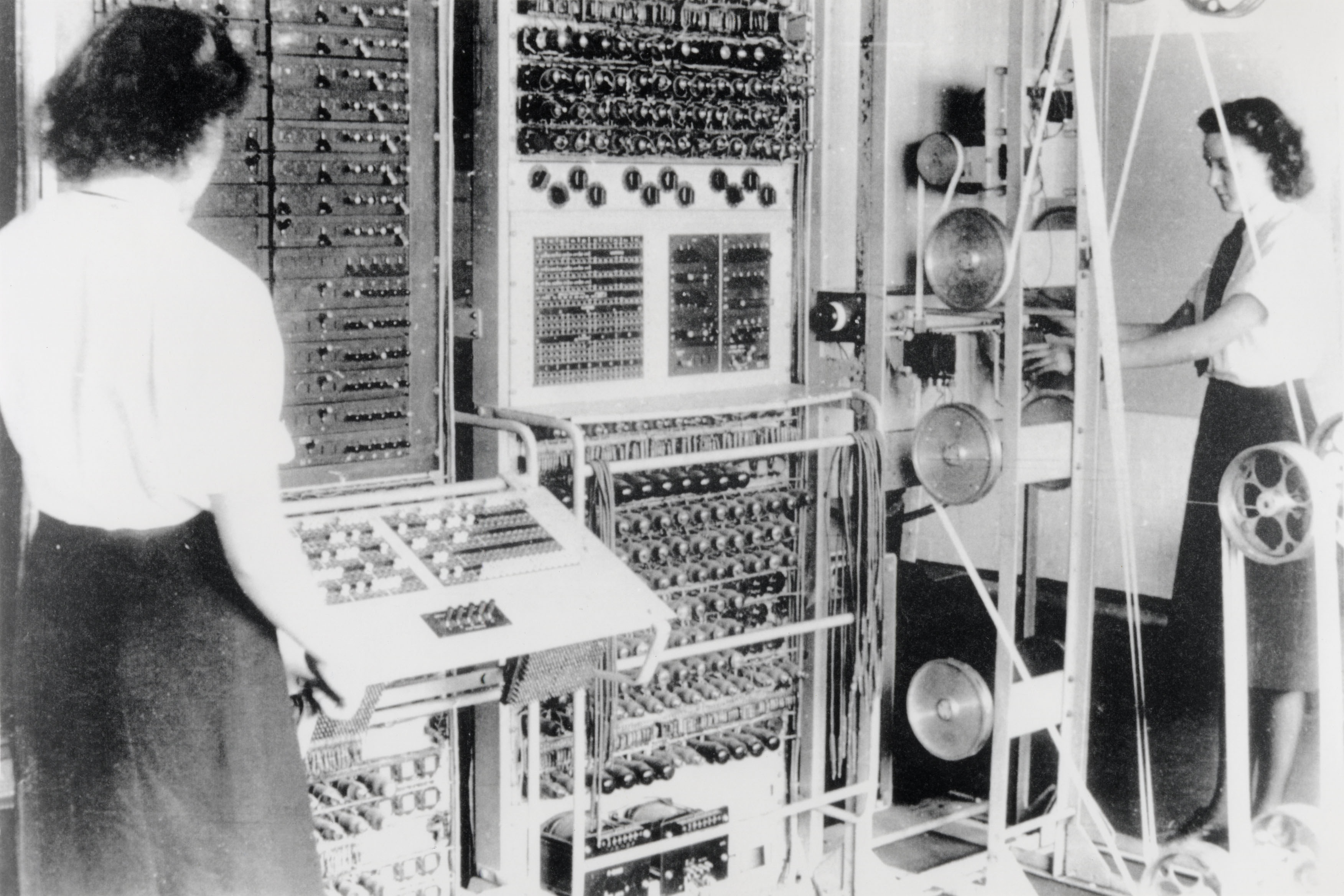
The Bletchley management immediately changed their tune and ordered Flowers to build more. They were used to read messages sent within the German High Command in the days leading up to D-Day. Colossus has since been defined as the greatest invention of the 20th Century. It was the worlds FIRST programmable computer.
Flowers was given £1000 for his war work, a pathetic sum considering what he had done. He then split this money equally with his colleges despite the fact that he had invested so much of his own money in the project.
Flowers applied to the Bank of England for a loan in order to build another Colossus like machine. They turned him down believing that such a machine was impossible. He was unable to inform them that he had already built one due to Cold War paranoia and the Official Secrets Act. In 1949 he was heartbroken to see that the Americans were claiming to have invented the worlds "first" computer.
Flowers died on October the 28th 1998.
Flowers really is an unsung hero. Tutte and Turing have also been treated very badly by history. However Turing has been the subject of god knows how many movies now, and has his own statue in the Foreign Office. Whenever Bletchley is mentioned in new reports and newspaper articles, his name is always quite rightly mentioned. Tutte has his own memorial in Newmarket which was unveiled last month. And what does Flowers have? Well, a small bronze bust kept away from the public at BT, and a road that used to be named after him.

Many people have argued that the Colossus replica built by Tony Sale is enough of a memorial for him. After all he was an engineer and perhaps one of his greatest achievements is now the centre piece for one of this countries greatest museums. However, the rebuild is in the National Museum of Computing so will on be seen by those visiting TNMOC or the Bletchely Park Trusts museum on the same site. He really needs to be given a public memorial like the one that Tutte was given, so that they will both be remembered and perhaps become household names like Turing.
During his first trip to Bletchley Park he helped Alan Turing develop a new Bombe machine. Though this new Bombe was abandoned in its early stages Turing was so impressed with Flowers that he introduced him to Max Newman, who was working on the Lorenz enciphering system which was even more secure than Enigma (and had been broken by Bill Tutte.)Newman asked Flowers to help fix the Heath Robinson (which was an attempt at a machine to mechanise the breaking of Lorenz). Flowers insisted he could improve Heath Robinson. The Bletchley management believed that Flowers was wrong because Flowers wished to use valves in the new machine. So Flowers was forced to work with his small team of engineers at the Dollis Hill research facility.
In December 1943 Flowers had finished, Colossus was born and the digital age had begun.
Colossus was a giant machine which used a tape reader and 1800 valves. The valves wouldn't break unless the machine was turned on and off regularly.
The Bletchley management immediately changed their tune and ordered Flowers to build more. They were used to read messages sent within the German High Command in the days leading up to D-Day. Colossus has since been defined as the greatest invention of the 20th Century. It was the worlds FIRST programmable computer.
Flowers was given £1000 for his war work, a pathetic sum considering what he had done. He then split this money equally with his colleges despite the fact that he had invested so much of his own money in the project.
Flowers applied to the Bank of England for a loan in order to build another Colossus like machine. They turned him down believing that such a machine was impossible. He was unable to inform them that he had already built one due to Cold War paranoia and the Official Secrets Act. In 1949 he was heartbroken to see that the Americans were claiming to have invented the worlds "first" computer.
Flowers died on October the 28th 1998.
Flowers really is an unsung hero. Tutte and Turing have also been treated very badly by history. However Turing has been the subject of god knows how many movies now, and has his own statue in the Foreign Office. Whenever Bletchley is mentioned in new reports and newspaper articles, his name is always quite rightly mentioned. Tutte has his own memorial in Newmarket which was unveiled last month. And what does Flowers have? Well, a small bronze bust kept away from the public at BT, and a road that used to be named after him.
Many people have argued that the Colossus replica built by Tony Sale is enough of a memorial for him. After all he was an engineer and perhaps one of his greatest achievements is now the centre piece for one of this countries greatest museums. However, the rebuild is in the National Museum of Computing so will on be seen by those visiting TNMOC or the Bletchely Park Trusts museum on the same site. He really needs to be given a public memorial like the one that Tutte was given, so that they will both be remembered and perhaps become household names like Turing.
Saturday, 26 July 2014
Monday, 7 July 2014
Bletchley Park veteran talks about WWII code breaking experiences [Video] Says we need more women in security today
http://content.bitsontherun.com/previews/ZHZWGuA9-sy1F28d9
Wednesday, 25 June 2014
Tuesday, 24 June 2014
Operating the Bombe: Jean Valentine's story
Interview given by Jean Valentine (possibly it was conducted by Google)
Saturday, 7 June 2014
BT commemorates role of GPO in Dday landings.
Found this on Google. I was thinking Today and Yesterday during the D-day celebrations that no one seemed to be mentioning the role played by Bletchley and the Code Breakers during the build up to the landings.
This article sums up briefly the role played by Bletchley and the GPO which is now BT during the war. However it would have been nice if this was picked up in the mainstream news and coverage of the celebrations yesterday.
BT commemorates its role in D-Day landings- The Inquirer
Saturday, 12 April 2014
Updates
Future plans for blog
I plan to start another blog if I have time about the Y service as they were fundamental to the workings of Bletchley Park and receive even less recognition.
With regards to this blog I intend to go into as much detail about the Testry as I can and then write about the Polish code breakers who initially broke into Enigma and then perhaps Turing or the Newmary.
Other relatedish news
I went to a Within Temptation concert last night in Manchester with my girlfriend and I don't quite understand she stopped singing to tell us the story about how a gay man invented the worlds first computer in Manchester and then killed himself with a poisoned apple. While this is wrong and very annoying it does show that the situation is improving and maybe people in that audience will gonaway and research it :) apart from that tiny detail it was a great night out. at least turing is getting public recognition even it was the wrong thing and the wrong place.
I'm going to post more about the testery either later or tomorrow morning, however I think that that is enough procrastination for now. Back to tidying.
Wednesday, 9 April 2014
Captain Jerry Roberts
Captain Jerry Roberts MBE died last Tuesday at the age of 93. Captain Roberts received his MBE as a result of his work trying to promote the of work his former colleges at Bletchley. He believes that the four T's are yet to receive enough recognition for the work they did during the war. The four T's stand for the Testery , Tommy Flowers, Alan Turing and Bill Tutte.

Roberts is one of the reasons why I have started spending one Saturday a week producing this badly written rambling blog, because he inspired me I suppose to try and help the heroes of Bletchley Park get the recognition they deserve.
Captain Roberts arrived at Bletchley Park in 1941 after completing his degree in German at University Collage London. One of his professors at university Prof. Leonard Willoughby was a former Room 40 Code Breaker during the first world war and recommended him to GC&CS.
Before he arrived at the park he was first interviewed by Victor Marks who would be become a shift leader in the Testery. He told Masters that he enjoyed chess and attempting the Times Crossword puzzle. He was then sent to the Park.
When he arrived at the Park he was interviewed again, this time by senior Code Breaker and legendary code breaker John Tiltman. Roberts and the other members of the Testery helped to break the Tunny Cipher used by the Lorenz 42 which was used by the high ranking members of the German military. Roberts once decrypted a message signed by Hitler himself.
Tunny was so complex that it had the allied codebreakers completely stumped for the first two years of the war. The machine had 12 wheels compared to Enigmas three. the first five wheels enciphered the letter, then the next five enciphered it again. There were two wheels in the centre which added stutters to the code. These were random characters which were designed to make the enciphered message appear random. The total number of possible encryptions multiplies out to around 16 million million million. The fact that Roberts and his team were breaking this code by hand for the first few years of the war is remarkable.

After the war Roberts was transferred from Bletchley to the War Crimes Investigations Unit. Here he again put his German to good use and learnt to drive for the first time. He didn't enjoy the work as much as his work at Bletchley.
He then went on to have a successful career in marketing and advertising until he retired in 1993.
In 2002 he was finally able to talk about his work at Bletchley Park and it wasn't long before he began campaigning to get his colleges work recognized.
https://www.youtube.com/watch?v=OqxDEm0BTw0
Subscribe to:
Posts (Atom)